
guarantee you'll be thinking about this
a personal tour through one of my favorite short essays of all time

Six paragraphs.
That’s all it takes, and Brian Doyle leaves you changed.
“Joyas Voladoras”1 is one of those essays that brands itself into memory. The afterimage burns like you’ve come in from a sunny summer day to a dark room. Years pass, you forget the specifics, but there’s the shape of it floating behind your eyelids. The memory of the way you felt to read it.
(The text exists in its entirety below, but you can find a plain-text version here, or read this post in Substack for easier viewing.)
Let’s nestle into a long moment together:
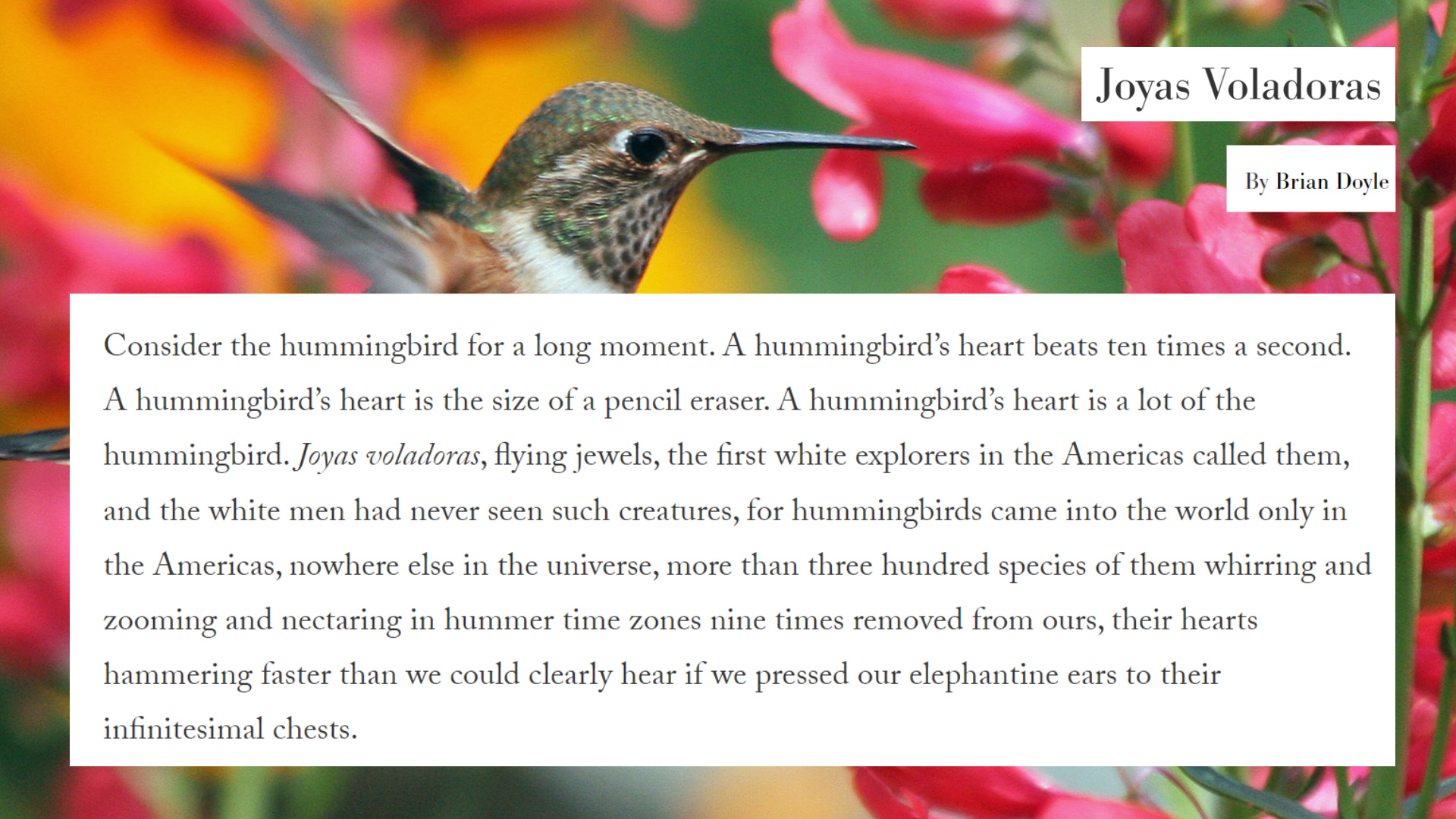
From the start, details that catch my attention…
the anaphora (repetition) of the sentence-starter “A hummingbird’s heart…”
how the stacatto rhythm of the first four sentences (~2 lines of the paragraph) gives way to the riot of the fifth sentence (which alone is ~6 lines)
the playfulness of the invented verb “nectaring” and the concept of “hummer time zones”
“elephantine” // “infinitesimal” — Doyle plays with distortion of scale, magnifies the human ear until it’s the size of an elephant’s
In the second paragraph, we nosedive deeper into the wonder of the hummingbird:
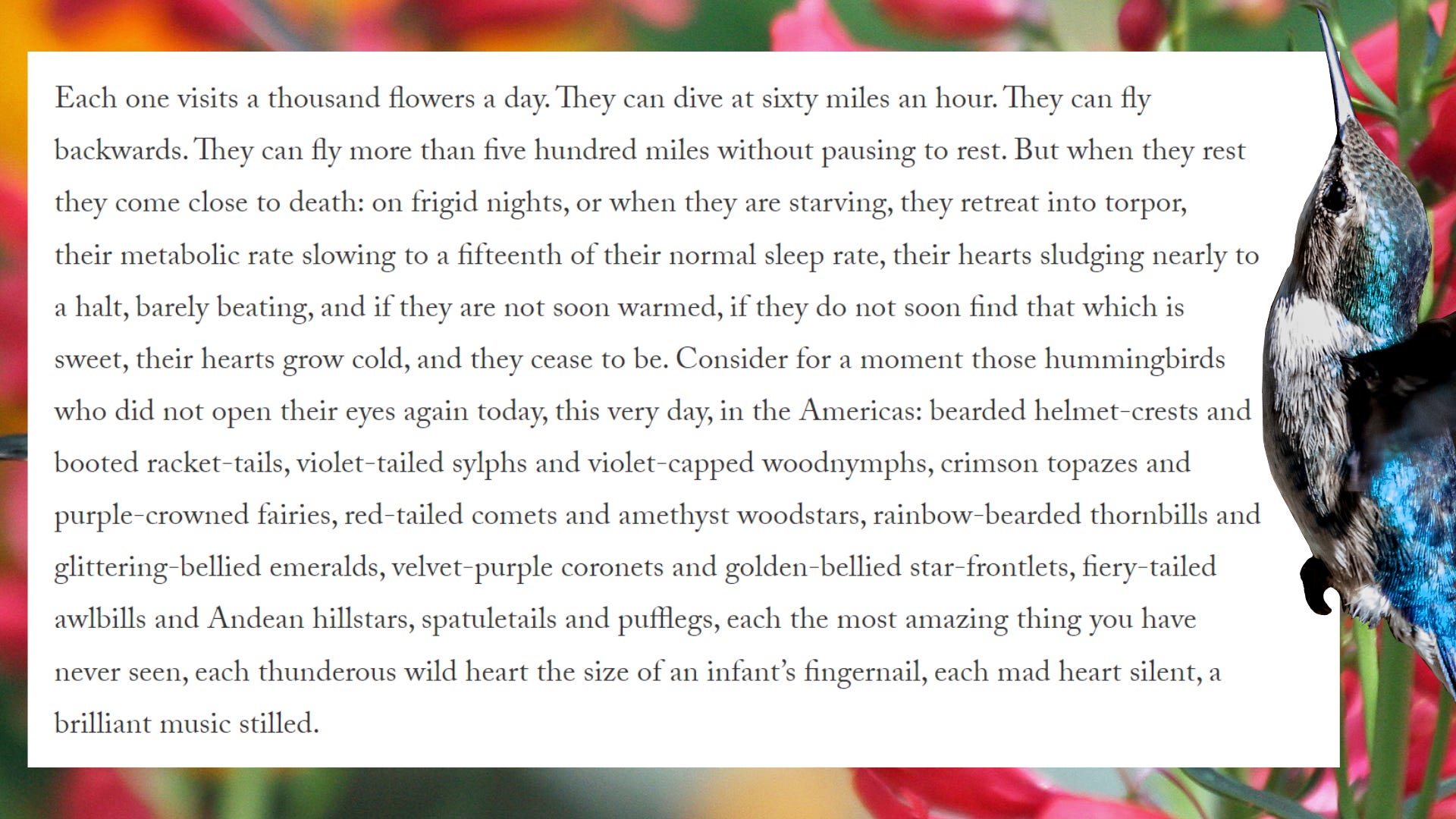
Again, a paragraph that starts with blunt, matter-of-fact reportage, and then flies away on the mad rhythm of a few run-ons (a sentence structure which mirrors the fury of the hummingbird’s fight for survival.)
“Consider for a moment” echoes back to the start of the essay, and then we get a litany of the diverse subspecies of hummingbirds whose ranks dwindle by the day. This specificity heightens the sense of loss — it’s not just any hummingbird lost, but a “purple-crowned fairy,” a “rainbow-bearded thornbill,” a “golden-bellied star-frontlet.” The color and texture in this list heightens the sense of verve.
It turns out these are the actual names of hummingbirds, but I used to think that Doyle inserted the adjectives (“purple-crowned,” “rainbow-bearded”) himself, as a way of “showing” us what certain hummingbirds look like and making a list come alive.
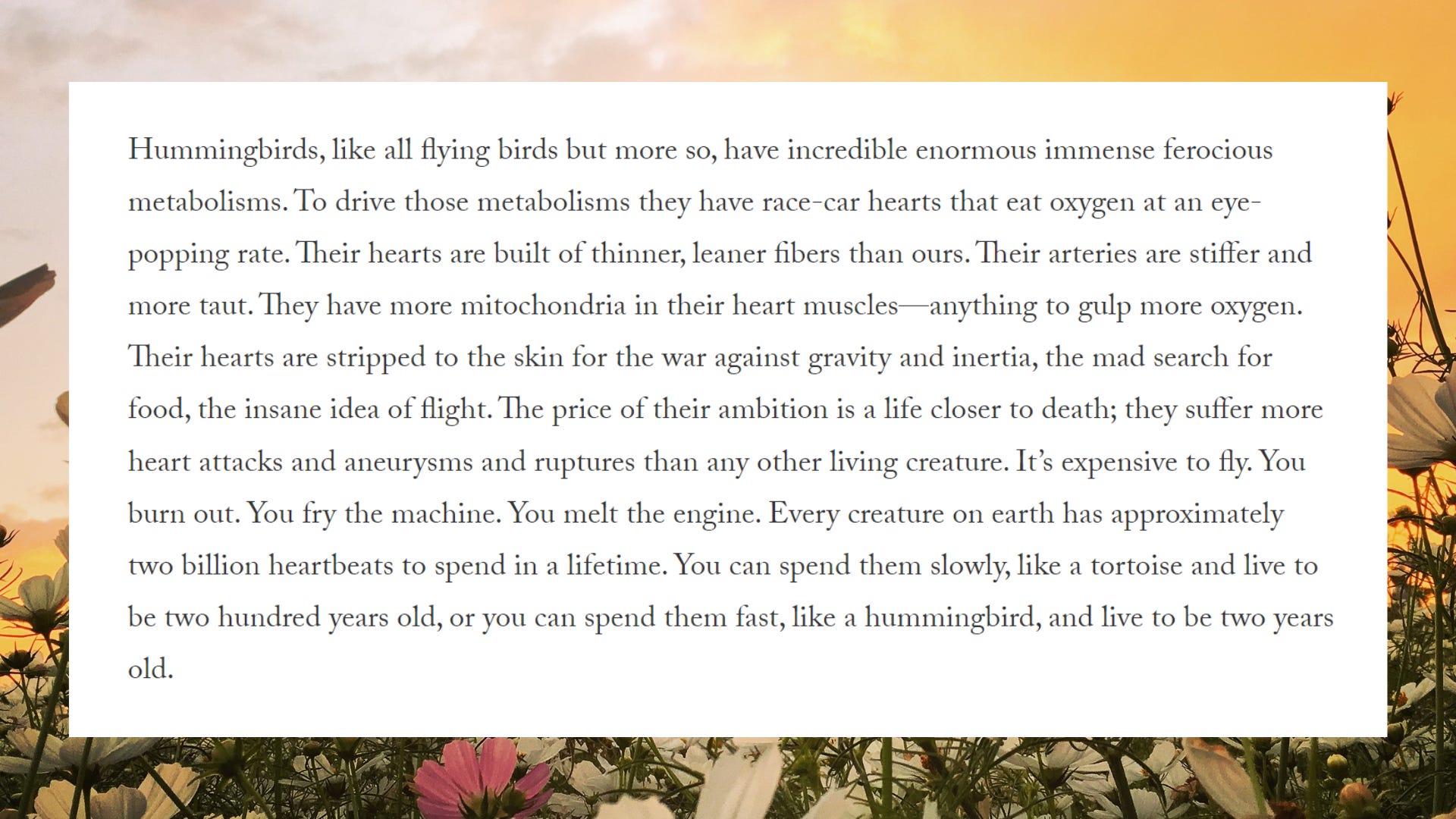
“incredible enormous immense ferocious” flies against all writing advice — and revels in a childlike jubilance, which continues with “race-car hearts.”
“You burn out. You fry the machine” switches to second person
“You can spend them slowly […]” implicates you, as if you’re a choice away from living as a hummingbird or a tortoise.
And we veer away from the hummingbird, into the prospect of other creatures — a vibration that clues us into this upcoming fourth-paragraph swerve:
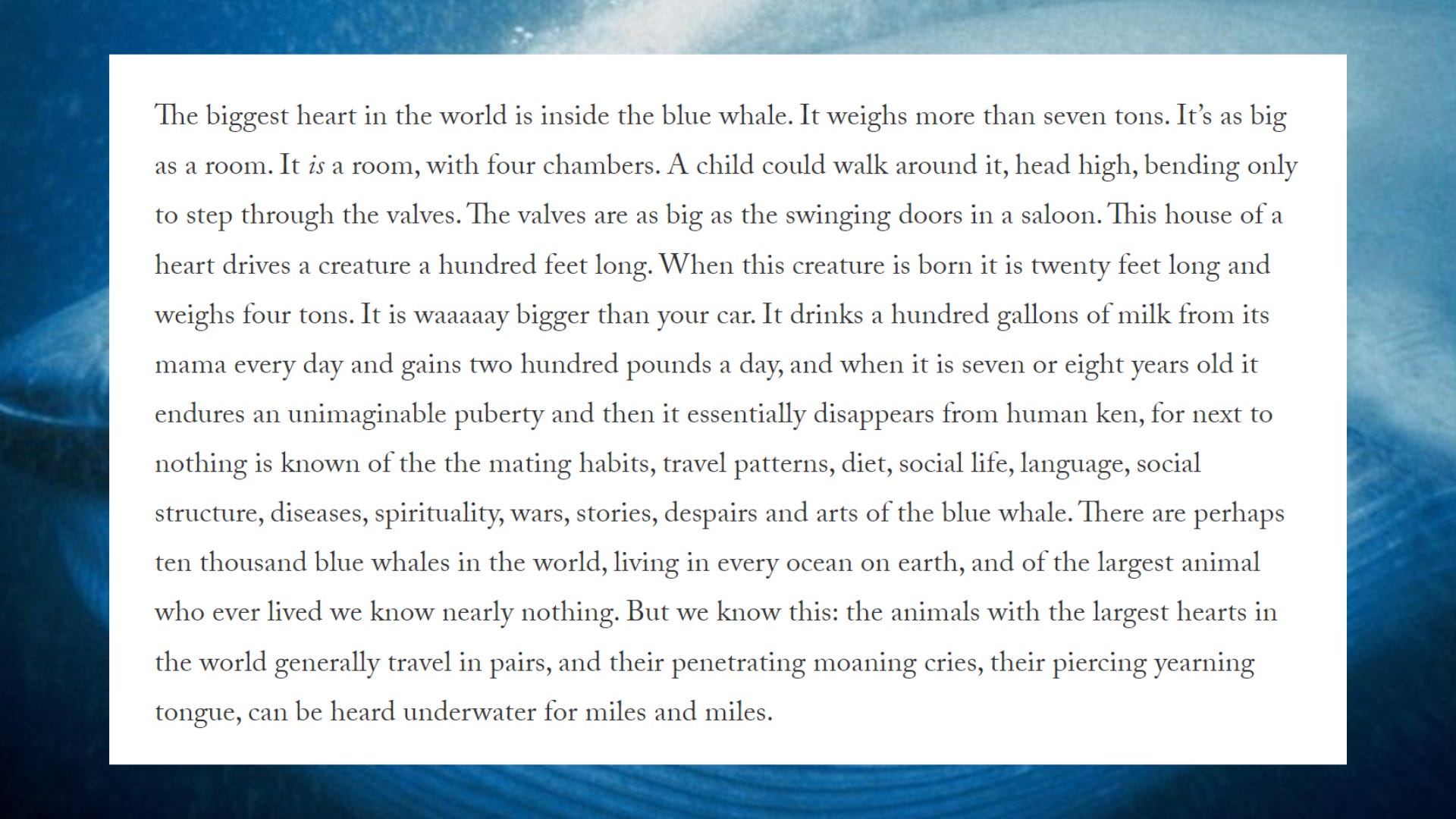
“A child could walk around in it, head high, bending only to step through the valves” does the same thing as the paragraph 1 sentence about pressing our “elephantine ears” to a hummingbird’s “infinitesimal chest”: it recontextualizes this mysterious animal in terms of our human experience.
“waaaaaay bigger than your car” furthers the tone set by “incredible enormous immense ferocious,” and plays with visual text arrangement, too
“wars, stories, arts and despairs” signals another important swerve: from the idea of a biological heart to the human idea of heart as emotionality, the non-material soul.
just as the tone tipped more melancholy at the conclusion of the hummingbird section, we get the blue whale’s “penetrating moaning cries,” the “piercing yearning tongue.”
In this paragraph, the camera zooms out and whirls around. We don’t stay with a single subject. It churns. It indicates that there’s another swerve coming. We’re just in a centrifuge, waiting to be spat out on the other side of the swirl.
And we land at the beating heart of the whole piece:
Wow.
So much held in a heart in a lifetime.
It’s been said2 that a good ending should shine a flashlight back through the rest of the piece, illuminating what’s come before, and giving the reader a new way of seeing. When we hit So much held in a heart in a lifetime, all the scientific detail about hummingbirds and blue whales feels less like a destination in itself, and more like a stepping-stone path constructed just so we could arrive at this castle.
Devices like run-on structures and cascades of adjectives previously created a childlike appeal — which leaves us all the more shaken when we hit:
When young we think there will come one person who will savor and sustain us always; when we are older we know this is the dream of a child, that all hearts finally are bruised and scarred, scored and torn, repaired by time and will, patched by force of character, yet fragile and rickety forevermore, no matter how ferocious the defense and how many bricks you bring to the wall.
This final paragraph, on the mystery of the human heart, could merit a post of its own. It’s so rich with paradox: we’re alone and separate, yet vulnerable and interconnected.
And then: that killer final sentence. It’s a collage. It’s a montage. The “camera lens” makes rapidfire cuts through images. Specificity creates relatability. Whether or not we’ve personally had each of these experiences, we can see them. Smell them. And so they might as well be our own experiences — we’re experiencing them now, as we read them. The fleeting glimpses — not so different from the way we experience our own memories:
You can brick up your heart as stout and tight and hard and cold and impregnable as you possibly can and down it comes in an instant, felled by a woman’s second glance, a child’s apple breath, the shatter of glass in the road, the words I have something to tell you, a cat with a broken spine dragging itself into the forest to die, the brush of your mother’s papery ancient hand in the thicket of your hair, the memory of your father’s voice early in the morning echoing from the kitchen where he is making pancakes for his children.
Read more:
a verve/swerve manifesto

“I have to constantly re-identify myself to myself, reactivate my own standards, my own convictions about what I'm doing and why.” — Nina Simone
Shoutout to my teacher and mentor Matthew Vollmer for first introducing me to this piece!
I’m not sure of the original source, but this is another thing I heard from the one & only Matthew Vollmer
Wonderful analysis of a really striking piece of work. Reading the essay first on its own, then again as you broke it down, added texture and perspective that dramatically shifted how I perceive the art and helped me feel like I understand it more comprehensively. The romanticizing of the hummingbird stands in contrast to my personal experience which has been watching them engage in dogfights (as in the world war 2 plane battles - birdfights better here?) over a feeder or buzzing past my head to ward me away. The intersection of nature and humanity is so interesting and this piece deftly swerves from objective biology to subjective human experience. Look forward to the next one!